Five Figure Writer

The freelance writer, refined.

  • WRITING
  • EARNING
  • MOMMING
  • ABOUT
  • B2B WRITING INSTITUTE

No-BS Stress Relief & Relaxation for Writers

December 3, 2015 By FiveFigureSarah

Congrats to the winners Robert, Justine, and Alex! I hope the free app makes it easier to de-stress and focus on your awesomeness :-).
No-BS Relaxation and Stress Relief for Writers - Five Figure Writer

The sales brochure for freelance writing always starts with the benefits: Work less, make more! Choose your projects! Escape the cubicle! Live location-independent!

(And hey, I tout them, too!)

So it’s no wonder that the first few months or years of working for yourself feels like slamming full-speed into a brick wall. Sure, you can work wherever you want…. but most of the time you’re holed up in your apartment, a little sweaty, wondering if you drank any water that day. And yes, you can choose your projects… but more often than not you choose boring projects that pay you consistently (when you can find them).

Until you make the effort to find those special clients and chase the white rabbit of work-life balance that syncs your business up with your true self, the whole shebang is pretty darn stressful.

Until you make the effort to find those special clients and chase the white rabbit of work-life balance that syncs your business up with your true self (which are both important goals to pursue), the whole shebang is pretty darn stressful.

What’s So Bad About Stress?

Obviously stress can be good. It can save you from picnic-snatching bears in the Smokies and alert you to bad relationships you need to ditch. But prolonged stress like the kind that occurs when your livelihood relies on your hustle is no bueno.

When is my next check coming?
Why won’t this client pay me on time?
Why do I keep saying yes to bad clients?
When will I get to write about what I want?
When can I stop marketing or selling myself?

I don’t know about you, but even though I’ve handled most of these questions myself, reading them still made my blood pressure jump up a little bit. It’s stressful. It keeps you up at night. And it can…. Completely destroy your business, health, and life.

Chronic stress destroys your performance, eats away at your sense of self-reliance, paralyzes you from achieving your potential, and probably is the reason you get a stomachache at night.

Chronic stress destroys your performance, eats away at your sense of self-reliance, paralyzes you from achieving your potential, and probably is the reason you get a stomachache at night.

Not only that, stress can trigger chronic illnesses! You’re looking at sad sack proof of long-term stress triggering (thanks a lot, classroom teaching experience) an autoimmune disease that now plagues me on a daily basis.

So Let’s All Quit! (Not)

So, is the answer to fold up your lemonade stand and politely backstab your way back into the rat race?

No, I don’t think so, (not yet, at least). When you’re committed to working for yourself, the solution is never to give up. The solution is to identify the problem (stress), learn about it (this blog post), and implement sensible changes in your life to manage your stress (the next section).

Self-knowledge is the key to self-actualization, and self-actualization is the key to running a badonkulously successful business.

If you don’t implement any strategies, yes the stress may overwhelm and paralyze you. And even if you implement all of them, it still may be too much. But self-knowledge is the key to self-actualization, and self-actualization is the key to running a badonkulously successful business (just go with it).

Crack a smile or a seltzer, pull up a chair, and check out these no-BS strategies to help relieve the stress that comes with running a freelance writing business.

Divide & Conquer Your Problems With Worry Flashcards

Every freelancer is unique, I really believe that. But listen, our problems are not. It’s always, always, always cash flow, clients, and purpose. Every problem I’ve ever had and every problem a client has ever brought up came back to one of those three things:

I don’t have enough cash flow. / I have cash flow but I’m not doing work I love.

I don’t have any clients. / I don’t the clients I have. / The clients I like don’t pay well.

No one’s hiring for work I love./ The work I love to do doesn’t pay. / I don’t know what I want to do with my skills.

The main problem is not these individual problems. After all, you can probably find a great book to read (or mentor to talk to) about any one of them. But when all of these problems gather in that smelly hall closet outside your office and jump you at once, it’s completely unmanageable.

When all of these problems gather in that smelly hall closet outside your office and jump you at once, it’s completely unmanageable.

Your brain is completely panicked and sets off all of your emotional alarms. Unless you redirect it, that day is only good for a hot bath and a cry sesh about how unsustainable freelancing is.

No-BS Stress Less Tactic:

This good old standby comes to us from Jess Lively back when she ran a jewelry and products company. Her personal blog had a post that shared her stress-less strategy of Worry Flashcards which I have since used several times for this-is-the-end-of-the-world moments where life crashes down on you from all sides. It always helps!

Jess does it a little differently, so read her blog post for another perspective. My instructions go something like this:

Take a pack of note cards (or cut up a sheet of paper) and write one problem on the front of each card. Keep going with all of your worries — both professionally and personally — until you can’t think of another thing that bothers you.

Review the cards and sort them into personal and professional problems (if you’re in the mood to approach each separately). Read the card out loud, and then — focusing only on that problem — write a few ideas for what you can do to make progress with the issue on the back of the card.

For example:

I don’t know what I want to do with my business. ==> I should read a book about finding your purpose. I’ve seen a few great recommendations like Road Map. Also, it’s normal for people to now know what they want to do. I need to be patient with myself while I learn about possible business trajectories. Also, I bet other successful people have felt this way and would respond positively to a vulnerable message from me. Who can I email right now to ask their advice?

I don’t have enough cash flow. ==> I would be less stressed about money if I had a few thousand in the bank while I’m waiting for checks from clients. I should set a goal to put $3,000 in a rainy-day-check-is-late account to take that pressure off of me. Also, I have one reliable client who pays correctly. I wonder if I can repeat what I did to get that client to get more clients like them. My goal for next month is to pursue three more leads like that client.

BAM! Seemingly-insurmountable problems dissolve into soft balls of yarn that you can throw to your cat. This won’t solve any of the problems, but it will help you organize your stressors and see that each one by itself isn’t the end of the world.

For an added Christian approach to this exercise, consider taking all of those note cards and physically placing them under a cross or crucifix in your home. Again, this won’t solve your stressors, but it will help you physically act out the process of “Let go and let God.”

Move Your Body Every Day (AKA Exercise)

Wait, wait! Before you close the browser and vent about how I promised there was no BS, I want to encourage you to re-think the value of exercise. Yeah, Women’s Magazine and your mom all tell you to exercise more. But when you look at exercise from the right perspective, it’s not about weight loss and rock hard abs. It’s about the proper functioning of the cells of your body, and your brain (you know, that thing that you use to make an income) is made up of cells!

Women’s Magazine and your mom all tell you to exercise more. But when you look at exercise from the right perspective, it’s about a lot more than weight loss and rock hard abs.

Here’s your new perspective on exercise: Moving your body is more important (and has a more powerful effect on your brain and body) than any medication you could take. Within minutes of moving your body, so many positive writer processes go into play (your subconscious that brainstorms, your heart that pumps fresh blood, your brain that thinks about your setting in a new way) that it’s a completely integral way to keep your mind fresh and your business humming along.

No-BS Stress Less Tactic:

Exercise when you’re stumped, and exercise daily! I’ve had many work days that started with me stressed to the max and staring at my keyboard. I manhandled my brain (one of those freelance writer super powers) to pump some iron with a small free weight and do a load of laundry, and I returned to the computer to pound out excellent work.

So, ignore those voices inside your head that say “This is the same old same old lame idea, and I just don’t want to move my lazy butt.” Set a timer, go for a 15 minute walk, and come back in. Then do it every day. It will change your business.

Laugh Your Butt Off (On The Clock)

Again, no BS here. Laughter is a treatment for chronic health conditions and can interrupt your brain’s negative reaction to mental and physical stress triggers. Laughing flips the switch and relaxes your brain, allowing you to be creative again… literally throwing a stop sign in front of the hormones and instincts that say “Oh crap, the world is ending again and it will be ending forever!!”

No-BS Stress Less Tactic:

When the stress crests, take over your old lizard brain with your modern mouse-clicker and find something funny. My go-to is the What Should We Call Paleo Life Tumblr and the Twitter Moments of Hats On Owls.

The real trick here is to set a timer so that your type-A brain won’t feel like you’ve lost control of the whole day. (AKA When I’m in stress mode, I have to use a timer or my mind will spiral into “the whole day is wasted! I’m dying!” mode). Get a good belly laugh in there, and five minutes later get back to work!

Redirect Your Negative Thoughts With Motivational Art

The human brain will fall back on negative stuff over and over again. It’s up to you to interrupt that process with positive messages that keep you going. (That is…. Every brain is sending negative thoughts to its owner. Some owners know how to cut in line, though!).

The human brain will fall back on negative stuff over and over again. It’s up to you to interrupt that process with positive messages that keep you going.

AKA, when your negative thoughts are spiraling with ideas like, “I’m not working hard enough – I won’t get enough done today!” which is what you’re doing instead of working, it’s time to interrupt that process and redirect with something more positive.

No-BS Stress Less Tactic:

Set a timer and head out on the hunt for inspirational and positive quotes. If you’re artistically inclined (or not!) make the quotes pretty with a thick pen and some illustration or fancy lettering. You can also spend some time on Etsy or Instagram liking and buying quotes from the fantastic artists there (my favorite new discovery is Joyful Papery).

Here’s what I have hanging around my desk for times I feel super desperate or overwhelmed:

“It is only when everything is hopeless that hope begins to be a strength.”

“Come, Holy Spirit”

“The Lord will fight for youl you need only to be still.” Exodus 14:14

“Do not conform yourselves to this age but be transformed by the renewal of your mind, that you may discern what is the will of God, what is good and pleasing and perfect.” Romans 12:2

Whether it’s a cute note from your spouse, a meditation from Marcus Aurelius, or a funny Dilbert comic (hey, I won’t judge), you can train your brain to be more positive by manipulating your surroundings.

Set The Tone of Your Day With Meditation, Not Deadlines (Plus a Giveaway!)

Wake up, read Feedly, check email, start stressing. Does that sound like your typical morning? Unfortunately, that’s not much different from what everyone in the corporate jungle is experiencing. If you’re like me, you started this business to improve your quality of life, not relocate it to a home office, so the idea that you’re experiencing the same stress or miserableness is unacceptable.

Despite being in control of my business, I am still not in control of my day.

Too often the tone of my day gets set by my deadlines. A good day is when my work is all done. A bad day is when I have tons of deadlines and phone calls mixed in (you know how nervous I am about phone calls). This is natural, but it’s also reactive: despite being in control of my business, I am still not in control of my day. My mood is often guided by things outside my control, and my day follows the course.

No-BS Stress Less Tactic:

Everyone is screaming bloody murder about how peaceful relaxation is. I hate to jump on a trend, but I think it can really help writers focus and gain control. So much of what we do is internal, so controlling those internals can have a huge impact.

There are tons of free meditative programs and podcasts out there. I usually read to this before bed or work with this album playing on Apple Music. But from time to time I also do specific meditation sessions for 10 or 30 minutes. And that’s a perfect introduction for the first blog giveaway: OMGMeditate!
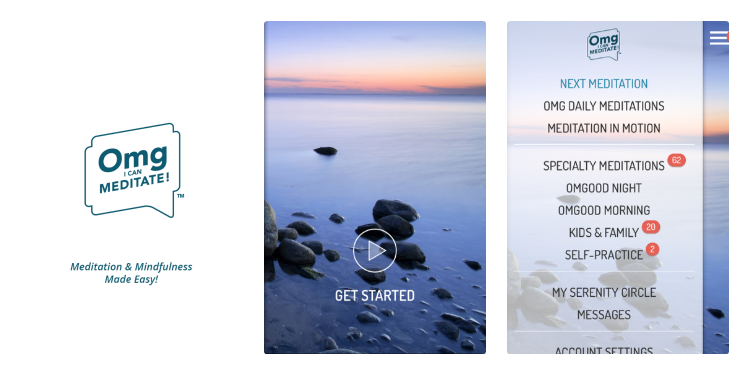
OMGICanMeditate Five Figure Writer

This app sits on your smart phone and makes it a no-brainer to take 10 minutes to yourself. You can start a daily meditation program, set a relaxation “mission” and get reminders throughout the day, or just tune into specific meditations as you find ones you like. For freelancers with kids at home, there’s also a child, tween, teen, and family options to go with. Talk about thorough! My favorite section is the OMGood Night function, because I naturally think of meditating when I’m winding down at night.

Today I get to give away five 3-month subscriptions to OMG I Can Meditate premium. The perfect amount of time to experiment with your preferences and start a meditation habit before you decide to keep the premium account. Keep reading to find out how this can be YOU – without the awkward Rafflecopter-sell-your-soul-on-Twitter entry price.

Go Forth and Stress Less

Are you feeling chronically stressed out by freelancing? How do you handle it? Do you think freelancing is more or less stressful than other jobs you’ve had in the past?

Want to Get a Free 3-Month Premium OMGMeditate App?

Here’s what you’ve gotta do:

  1. Answer one of these questions in the comments below RIGHT NOW! (I’ll pick a winner on December 17th).
  2. Share this post with a friend who can use it (via email or social network… I’ll trust you to follow through on that!).

The five most compelling answers will each win a 3-month premium subscription to OMG I Can Meditate and have one less excuse to being in charge of your business but stressed the crap out all the time (your BFF/your cat will thank you).

Filed Under: WRITING

4 Freelancing Superpowers Nobody Told You About

November 19, 2015 By FiveFigureSarah

4 Freelancing Superpowers Nobody Told You About - Five Figure Writer

Sometimes the world of freelancing and consulting seems like a Good Old Boy’s Club. That is, you’re either “in it,” or you’re not, you either “get it,” or you don’t. And you either “have what it takes,” or you’re doomed to fail.

Fortunately for my current lifestyle (because if I kept that attitude, I would never be able to do what I’m doing now), I disagree! The process of starting a freelance business is a complex, exciting, and ever-evolving one. You often have to act without having all the answers or knowing what to do. And as you act without knowledge, you learn, you get better, and you grow special skills.

When you freelance, you often have to act without having all the answers or knowing what to do. And as you act without knowledge, you learn, you get better, and you grow special skills.

So, let’s get better at it! As I thought of the most helpful thing I could write about this week, it occurred to me that there were a few things I could do that it seemed like other people couldn’t do (or they were really, really impressed that I could do it). And it wasn’t party tricks like The Worm or making my knuckles bend in weird directions. It was daily things and habits I picked up over the years an that struck me as completely normal.

There’s the kicker: normal to established freelancers is often a superpower to the uninitiated.

Here are four superpowers I have picked up over the years which — if you pick up NOW — will save you tons of time, trouble, and help you build a successful business. I don’t know that I’ve seen anyone write about or talk about these four superpowers, so I knew it was time to share them with you guys:

1. Initiating the deep grind

When you write for a living, you learn pretty quickly that writing comes and goes with your mood (or muse, as some might say). I think this is the same for just about any creative pursuit. No matter how good I get, am still slave to the writing muse from time to time, especially when I have a lot of time on a deadline. However, sometimes I don’t have the luxury of not being in the mood or not cranking it out. Enter: initiating the deep grind.

The deep grind is my phrasing for those moments when you sit down to work, feel to your bone that you are not in the mood to do the work, and in a weird combination of mental and physical masterwork you dig through your desire to not-write and just start writing. You take nothing (no energy, no mood, no jive) and jive in the face of it all, pushing through the physical and mental momentum you have to do absolutely nothing to MAKE it happen.

The deep grind allows you to take nothing (no energy, no mood, no jive) and jive in the face of it all, the very essence of this hilarious video from Shia LaBoeuf:

Click here to see the video if you’re reading via email.

How to grow the grind superpower:

I can pretty much pinpoint the moment I began initiating the grind: I asked for a lot of paper extensions in college, and early in my career I would just frantically do work up til the deadline and perform whether it was done or not (ah, life as a teacher). I was good at pacing through my first corporate job, as well as my second. However, once I started freelancing and my ability to succeed was completely dependent on me “being in the mood,” I started to grind.

I developed the grind superpower by taking on high-pressure assignments (either the topic, the deadline, or the format) and making deadlines non-negotiable. You can replicate this by taking on regular high-volume assignments (such as a client with 3 blog posts due every Friday) and train yourself to grind them out the day before, no matter how you feel. By now, two years into it, I know that if I have not prepped the work, the grind is ON the day an assignment is due. For items without complexity (such as a single blog post) I know about how long it takes me to grind the outline, draft, and final editing session, and I can often fit these in on a single day.

For me, this can only happen once or twice per week. If I try to force it too much, I’ll break it and it won’t work for a while. But I have noticed that when push comes to shove and a deadline threatens to damage my reputation, I can always initiate the deep grind and come out on top.

(Pro tip: Always leave time to edit, or you’ll regret it! I use Grammarly and I’ve used an editor in the past.)

2. Inhuman self-control

Tangentially related to the deep grind (but more spread out over time) is the amount of inhuman self-control it takes to freelance in the long-term. The ability to make yourself do something you aren’t particularly excited about is an adulting skill that many of us use to do laundry. But inhuman self-control steps in when everyone you know is quietly working a 9-5 with a supervisor and still you get up and start working around 8, take a lunch break, and keep working until your spouse comes home (give or take a few kids, walks, or chores).

This kind of inhuman self-control is more than mere mastery of your desire to fidget on YouTube, read fun penmanship blogs, and write long and rambling emails about your health problems. It’s a fundamental ability you have (or learn) to discard work habits that threaten your self-employment and deaden yourself to the constant distraction of fun.

For example, as much as I love my husband, we agree that his place is in an organization with teammates and supervisors. Left alone (say, on a computer at home all day), the likelihood of him finishing assignments and scouting out work would decline by 50% each day that he got used to being unsupervised.  At the end of a given week, he’d be deep in the Apple product archives designing a fun new home office.

While I have my fair share of home office design jaunts (hello new discounted reading chair!) my average work day is much more somber: walk, eat, write, repeat. If I vary from that schedule (even if I’m allowed to), I start to feel anxious.

How to grow the self-control superpower:

Honestly, I don’t know how to help you gain more self-control. That’s going to be something you work with a counselor or business coach about, if it’s something you can change at all. In my very uneducated (on this topic) opinion, this seems more like a personality trait to understand (that is, I know I get distracted easily, so I will choose to work in a co-working space rather than at home) rather than something you can change. That said, challenging you that you can’t do it might be just the push you need… so, there’s your invitation: you can’t fix this! You can’t change! So go prove me wrong! :-)).

If I were to, say, try to help my husband be more focused, I would recommend he use his calendar to schedule really important assignments so that the pressure is off of him to remember. I’d also recommend all those productivity tools like RescueTime and StayFocusd (more here from 99U) to train you to not be distracted when you’re on the computer.

4 Freelancing Superpowers Nobody Told You About - Five Figure Writer

3. A positive outlook on everything negative

This one is more science-based than not. I started reading Jim Collin’s business book Good to Great, and the first chapter describes the most important characteristics of CEOs that take companies (in our case, small companies) from good business to great business.

One of the most important traits of the leader is the ability to remain unyieldingly positive and optimistic about your ability to succeed… while staying realistic and well-informed about the bad news, dangers, and downsides of the situation.

Feeling your business fade. Feeling doubt creep in. Feeling your inbox drying up…. And picking up your computer to dig it all out and up again.

As a writer, that means deciding to respond positively and politely to a rude editor’s email or a set of incoherent client feedback. It means putting your boundaries first, professionalism second , and “proving them wrong” or “showing them what’s right” as low on the list as possible so that your eyes always stay on the final goal (being successful, not being right).

Feeling your business fade. Feeling doubt creep in. Feeling your inbox drying up…. And picking up your computer to dig it all out and up again. That’s an emotional and psychological superpower you will not get far without.

How to grow the positive-but-negative superpower:

We all experience doubt and fear. We all feel our businesses fade some months and wonder what’s going to happen. But if you stay wishy-washy about your ability to succeed over the long haul or refuse to address the problems that come your way, you will likely fail. Instead, you need to learn how to maintain a positive outlook while understanding all of the risks and downsides of your situation. You must manage yourself like an external employee and following the process no matter how you feel.

If you feel like it’s really hard to acknowledge reality AND stay positive, seek out a supportive community or “success stories” of freelancers and businesses that will inspire you. Many great business books use case studies to show companies that were failing who turned it around, or people who started with a small idea and used thoughtful solutions to be successful in the face of adversity.

I’m also thoroughly enjoying Roadmap: The Get-It-Together Guide for Figuring Out What to Do With Your Life for its refreshing “reframe.” The intro chapters are taking a lot of time to clarify that  anxiety and the feeling of being lost are good things that lead you to greatness.

Freelancing is like life in so many ways, but especially in that it can be really, really crappy AND awesome at the same time (often within minutes). Acknowledging the crappiness (or the danger or risk of your situation) sets the stage for your eventual triumph if you can keep your head about it.

4 Freelancing Superpowers Nobody Told You About - Five Figure Writer

4. The ability to say goodbye

Speaking of boundaries, the ability to say goodbye (AKA “No”) is one of the most elusive superpowers you’ll ever try to master. Seasoned pros still find themselves saying “Yes,” far more often than they want to (especially women, research shows), and when you’re first trying to start your business, saying “No” seems like pure lunacy. However, your time and energy are limited. Saying “Yes” for anything you don’t want to do, that drains you, or that pushes you away from something more beneficial poisons your potential.

Think of it this way: if you’re over-booked with clients, it’s time to raise your prices so you can pick and choose who you work with. When your schedule is over-booked, it’s time to raise the standards on how you spend your time so  you can pick and choose what you work on. Eventually, the more successful you are, the MORE you need to say no to make sure that what you’re doing is the most effective or most enjoyable way to spend your time!

How do you know when it’s time to say goodbye to something in your business (a client, a contractor, or an office chair)? Watch for signs of emotional, physical, or mental discomfort. They’re all signs that something is not right in your business.

Watch for signs of discomfort when it’s time to say goodbye to something in your business.

Physical discomfort means something you’re eating, how you’re moving, or what you’re doing with your body isn’t aligning with its needs. Emotional and mental discomfort (business-related, at least) means that something you’re doing isn’t aligning with your purpose.

Discomfort isn’t a sign of failure; it’s a early warning siren for self-knowledge.

How to grow the goodbye/”No” superpower:

The only thing that grows this superpower (and build up the confidence to charge more) is a healthy ego and practice! Humility and understanding are attractive and valuable as a freelancer, but in this situation you’ve got to puff up your ego a bit and analyze why you deserve better.

In private, really talk up how talented you are and how much value you bring to the table, and decide that you’re too good to waste time being so nice to someone who sees you as a tool or an asset. Also consider how much other people are charging to do what you do (download Ed Gandia’s pricing guide to start with) so you have a different view of the value of your work.

I am still learning this lesson. I kept a client for a long time because I enjoyed our personal relationship (that is, I liked the client), even though the format of our relationship stressed me out and the organization of our relationship was pretty haphazard. After much internal struggle (how can I turn down work? It’s not that bad is it?) I finally “fired” the client… and I can now personally attest to the weight that lifts from you when you do it.

It’s like turning in notice at a bad job! It’s like breathing fresh air! Even if they’re good people. Even if they pay well. If the job makes you grind your teeth whenever you hear from them, say farewell!

(Pro tip: The words you use need to come from your heart and from your situation, but I found a few great problem client scripts from Nick Reese’s website here.)

4 Freelancing Superpowers Nobody Told You About - Five Figure Writer

What Superpowers Do You Have?

I love a good blog post,  but sometimes the comments are where the real magic happens. So, please share! What superpowers have you grown over the years and which would you add to this list?

Filed Under: EARNING, WRITING

3 Ways Your Storytelling Could Freak Out Your Clients

October 23, 2015 By FiveFigureSarah

3 Ways Your Storytelling Could Freak Out Your Clients - Five Figure Writer

Thanks to my last post on overwhelm, I’m slowly picking through the book How to Get People to Do Stuff by Susan Weinschenk.

One of the most empowering lessons in the book is about the power of stories.

We’ve been hearing about stories since it became a super popular content marketing trend about a year ago. In fact, a lot of the ghostwriting I was doing for top publications was about storytelling and the power of figuring out your brand’s story.

Well, guess what? That’s the truth.

Stories are important. As Weinschenk says, everything we do is related to a story we have about who we are and how we relate to others.

Everything we do is related to a story we have about who we are and how we relate to others.

And when there’s one story forming the basis for all of your reactions and decisions, that’s a very powerful story indeed.

But Weinschenk goes on. Did you know that most of the stories we have are unconscious? Both about ourselves and about others. That means we’re all carrying around a whole lot of baggage that either makes us good or not good at what we do.

Here’s a story for you, about a time I bombed a client call.

My Story About My Story of Work

It started out pretty normal. I used my warm emailing technique to make a connection because the company’s site had come up in my research. I got invited for an introduction by phone and kicked it off answering the typical “Tell me about yourself” interview question.

Now, for some reason I have a long history of being awful about this question (including a time I literally gave a five second “Ummmmmm”). It’s just so vague, even though know now that it’s just an invitation to talk about my relevant experience.

I started answering the question by explaining my background in education and my leap to writing and editing. And then, much to my horror, I heard the following words slip out of my already-grimacing mouth:

“I was writing for the internet in my personal time, but then I was laid off and thought I’d make a go of it!”

Oh my gosh. CRINGE. If I were that client, I would have rolled my eyes and gotten off the phone as quickly as possible. What an amateur. What a victim. What a hesitant, not-highly-paid rookie.

(Okay, I’m a little hard on myself sometimes, and I’m sure she wasn’t thinking mean things, but come on that’s a bad answer to give someone when you’re supposed to be the expert).

Call it a hunch, but after lurking on tons of freelancer mastermind groups I know I’m not alone on this. New writers (and sometimes even established writers) have stories about themselves in their heads and they let it come out at really inopportune moments (like first-time client calls).

Here’s what went wrong with this conversation and what we can all do to prevent it from happening to anyone again again:

You are not a victim, so don’t talk like you are.

As a part of my faith, upbringing, and general awareness of positive psychology, I believe in the power of positive thinking and in my own inherent power to change my situation. I am not a victim… and yet I told a story about myself to this client that was very much a story of victimhood.

I was laid off, and that was a downer at the time. But I rallied and turned it into a thriving career for myself with the time and wealth independence I need to be successful. Where is the victim in that? And why didn’t that come out on my call?

If you’re letting hints of victimhood into your story, invest time in proactively scripting those calls. Reflect on the significant events in your business life and career and carefully consider how you frame them.

Craft an authentic story that is a mix of vulnerability, honesty, and confidence in your ability to face any challenge that comes along.

Are you a well-paid, experienced expert? Or are you an “ooopsey-daisy!” victim who distances herself from her accomplishments? Your goal is to craft an authentic story that is a mix of vulnerability, honesty, and confidence in your ability to face any challenge that comes along.

I recently did an interview for another writing site and decided to reframe my story from the start. Instead of the nonsense from above, I wrote:

In 2013, I was laid off and these ideas were still kicking around in my head. I decided I had the skills and the passion and so I could make it work. I found my first independent clients and refined the way I ran my business over the years. 


Boom! This post from Nick Reese also has some great tips for crafting a compelling story about your business.

If you don’t make willy-nilly decisions, don’t talk about your business like you do.

I am the nerd in my relationship. I overanalyze how many plantain fries I can fit on a cookie sheet, I decide whether or not to do my hair based on how many people will see me (to get the most out of the hair products!), and I carefully plan out epic errand-running trips to make sure they’re efficient. So why the heck would I tell someone I started my business because “I wanted to make a go of it?”

Now, to be fair, that was true: I did start my business wondering if it was sustainable. But I did not, do not, and have not ever approached my work with that kind of whimsy or devil-may-care attitude. So why is it in my story?

Let this be a lesson to us all. Sometimes we try to hide our shyness by being too polite or making light of serious accomplishments. Don’t do that.

Are you an amateur fooling around to “see if this thing sticks?” If so, why would anyone ever hire you? If not, why would you answer questions with that attitude?

Are you an amateur fooling around to “see if this thing sticks?” If so, why would anyone ever hire you? If not, why would you answer questions with that attitude?

Instead, focus your story on your skills, your competence, and your deeper motivations about the work you do. I may have been laid off and started my business from a risky position, but I jumped in with a fire in my heart and a talent for putting words together. That’s the story I need to be sharing.

Don’t assume what people think of your career.

This is where one of those unconscious stories came into play. Coming from a family with established, stable careers (mostly engineering and military service), I faced a lot of “Are you still looking for a job? My friend is hiring…” early on in my self-employment.

To be fair, I wasn’t sure if self-employment was a good fit for me. It didn’t bother me that my network asked these questions, but it did sink into my story that it was a little crazy to be taking this big risk. And my, what an unusual, unfortunate, and possibly dangerous choice to make.

Can you see where this is going? If I think my career is a little crazy, obviously someone in a traditional career must also think that. And so I kick off the conversation with a hesitant description that distances myself from the fact that I work for myself.

There’s no ownership there. There’s no authenticity there. And so, there’s no connection there.

No ownership? No authenticity? No connection.

I told a story to myself  based on an assumption I made about the person I was talking to… and I was wrong. As it turns out, the person I was speaking with runs her own business on the side and was a full-time solopreneur for many years. If I had come in with a little more confidence about my purpose and why I do what I do, maybe we could have chatted about that and really gotten to know each other instead of simply ending the call and considering a trial assignment.

The lesson here is not to change your story entirely based on who you’re talking to. The lesson here is to sit with your story and take ownership of it. Figure out what  you’re holding onto about what other people think about your business (family, friends, more successful people, less successful people), and confront it with the truth. Then bring that truth to the call.

Tell Me Your Story

I would loooooooooove to hear your “before and after” story in the comments below. Who knows, you might meet and connect with someone who has a similar story and you will find your new Internet BFF!

P.S. Does that Unsplash photo freak anybody else out? That’s about as spooky as I get for Halloween!

Filed Under: EARNING Tagged With: authenticity, clients, introduction calls, pride, selling, storytelling, talking to clients

  • « Previous Page
  • 1
  • …
  • 9
  • 10
  • 11
  • 12
  • 13
  • …
  • 15
  • Next Page »

Freelance B2B writer. Building things and breaking them (including myself).

Making money with words since 2013 (& teaching others to do it since 2016).

Warning: There be opinions here.